
Insufficient nuclear workforce & expertise
The nuclear workforce needs to significantly expand to meet demand, but pending retirements present major challenges
Details
Core information and root causes
Why it matters
To meet growing demand for energy generally and for nuclear energy specifically, the skilled workforce to support the development and maintenance of reactors needs to expand. There’s a limited pool of workers with the necessary expertise, and many of them are on track to retire.
Within the United States:
The nation’s current nuclear reactor fleet employs approximately 100,000 people. That number is anticipated to rise to 375,000 by 2050 with the deployment and commercialization of advanced reactors.1
Nuclear energy’s workforce is trending older than other energy sources. The [2024] report found that 60% of the workers were ages 30 to 54 — higher than both the wider energy workforce and national average. Nuclear energy also had 23% fewer workers under the age of 30 than the overall energy workforce. That’s a shift from last year’s report, when the proportion of younger employees in nuclear was on par with other sectors. 2
Demand is projected to rise globally as well:
The IAEA foresees nuclear capacity more than doubling by 2050 in the high case scenario, and the Agency also projects there will be more than 4 million professionals supporting the nuclear power industry by 2050. But about one-third of the existing workforce is expected to retire by 2033, and upwards of one million new workers will be needed to replace those retiring and support the rollout of additional nuclear capacity. For nuclear power’s viability to endure well into the future, robust knowledge management and human resource development practices are needed.3
Construction Expertise for Nuclear is Highly Specific
“In the study of craft productivity on nuclear plants, 35% of tradesman blamed “foreman incompetence” as a major cause of productivity problems and delays. More generally, nuclear construction requirements are sufficiently different from other types of construction that building nuclear plants is its own field of expertise. For instance, the contractor for VC Summer and Vogtle 3 and 4 was from the oil and gas industry, and had no previous nuclear construction experience. Though oil and gas and nuclear facilities seem like they might have significant overlap in requirements (both require large amounts of piping and process equipment, both must be designed for severe environmental conditions triggered by catastrophic events), they apparently were unprepared for the difficulty of meeting nuclear construction requirements. Similar issues seem to be responsible for delays and cost overruns on Flamanville and Olkiluoto.”
— Brian Potter, Construction Physics4
“Long periods spent without construction of new plants also mean the nuclear supply chain withers, and workers’ and companies’ experience building nuclear plants is lost. Without companies with experience in building nuclear plants, new plant construction will inevitably be slower and costlier as competencies are re-acquired. Building nuclear plants cost effectively requires developing and maintaining an experienced nuclear workforce."
— Brian Potter5
Difficulty in Finding workers
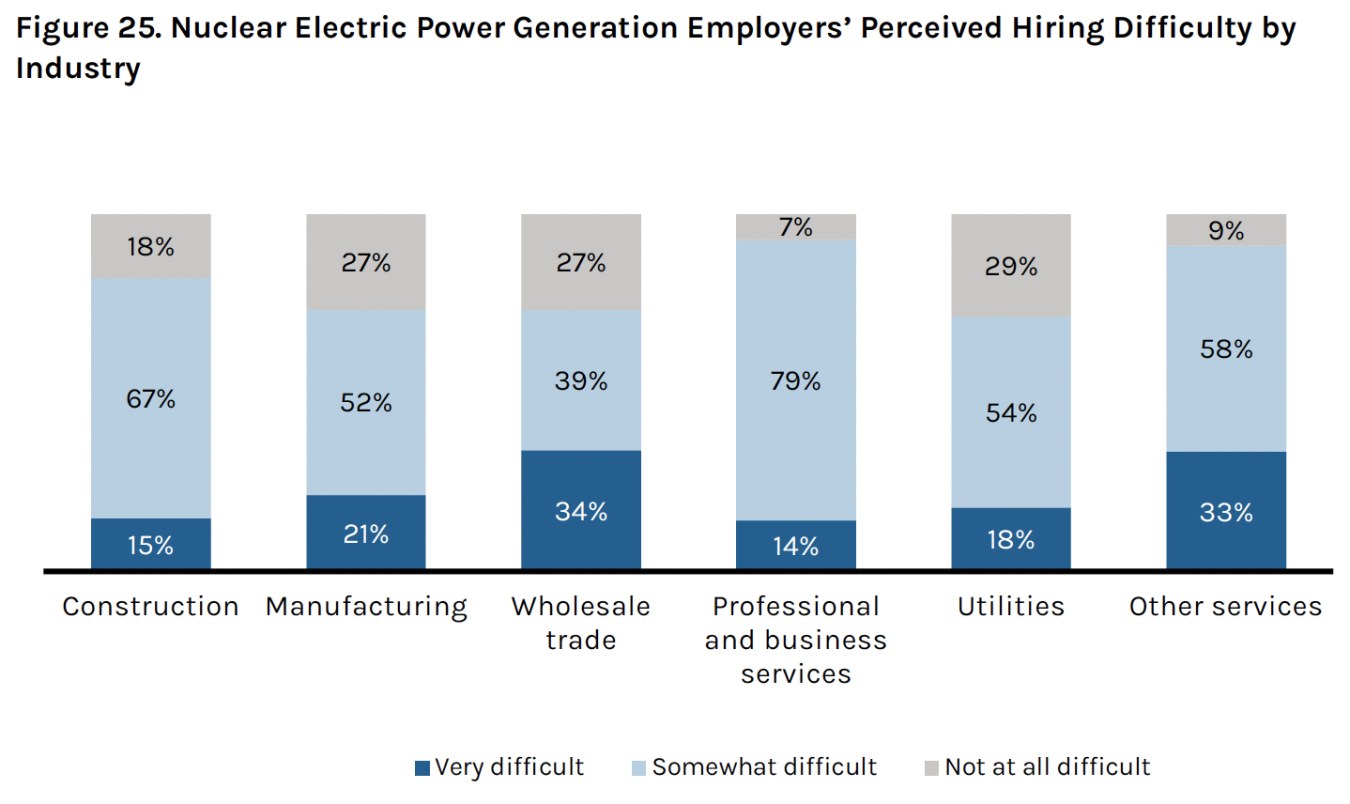
Employers also reported difficulty hiring workers across every industry in the nuclear energy sector — a trend that mirrored the larger energy workforce.
Roughly 90% of professional and business services employers said they experienced at least some challenges finding qualified workers, despite leading the nuclear field in new hires. Even utilities, which employed 3 in 5 nuclear energy workers in 2023, reported hiring challenges.2
Efforts
Current initiatives and solutions
U.S. Federal Government
US Department of Energy's Nuclear Reactor Safety Training and Workforce Development Program
Program funding targets university-led partnerships with industry, national laboratories, technical colleges, community colleges and universities, with a special emphasis on academic institutions located within 50 miles of an active nuclear power plant.
The program is intended to (1) ensure the nuclear fleet has a trained, dedicated workforce necessary to maintain safe and efficient operation; (2) create or expand upon one or more industry-recognized nuclear reactor safety credential; and (3) establish consortia to address gaps between skilled training needs and current nuclear workforce.
U.S. State Governments
Nebraska LB568 (2022): Establish a working group to award grants to community and state colleges to develop workforce training courses to meet the needs of the nuclear and hydrogen industries and appropriate $5 million to provide such courses. See also: Michigan HB5608, Virginia HB1779
New Jersey SB1615 (2024): Appropriate $1 million to establish a Nuclear Energy Apprenticeship, Training, and Employment Resources Pilot Program within the Department of Labor and Workforce Development for adult apprenticeship programs in nuclear energy infrastructure, nuclear energy utilities and other nuclear energy-related sectors.
- Michigan HB5607 (2024): Create the Nuclear and Hydrogen Graduate Attraction and Retention Program to award grants to recent graduates who are employed at a qualified electric generation facility for up to three years.6
Nonprofits
Nuclear Innovation Alliance (NIA)
“NIA works to enhance the broader advanced nuclear sector by organizing the annual Nuclear Innovation Bootcamp. The Bootcamp engages students and young professionals across diverse backgrounds and disciplines to teach innovation and entrepreneurship in the nuclear space. The Bootcamp is a critical industry pipeline for new talent and fresh ideas.”
Resources
Sources, references, and supporting materials
Additional Resources
- 5 Workforce Trends in Nuclear Energy U.S. Department of Energy; August 28, 2024
- 2025 United States Energy & Employment Report U.S. Department of Energy; 2025
References
- https://www.energy.gov/ne/nuclear-reactor-safety-training-and-workforce-development-program
- https://www.energy.gov/ne/articles/5-workforce-trends-nuclear-energy
- https://www.iaea.org/newscenter/news/sustainability-through-capacity-building-iaea-hosts-conference-on-nuclear-knowledge-management-and-human-resources-development
- https://www.construction-physics.com/p/why-are-nuclear-power-construction-370
- https://ifp.org/nuclear-power-plant-construction-costs/
- https://gain.inl.gov/content/uploads/4/2025/01/State-Nuclear-Policies.pdf