
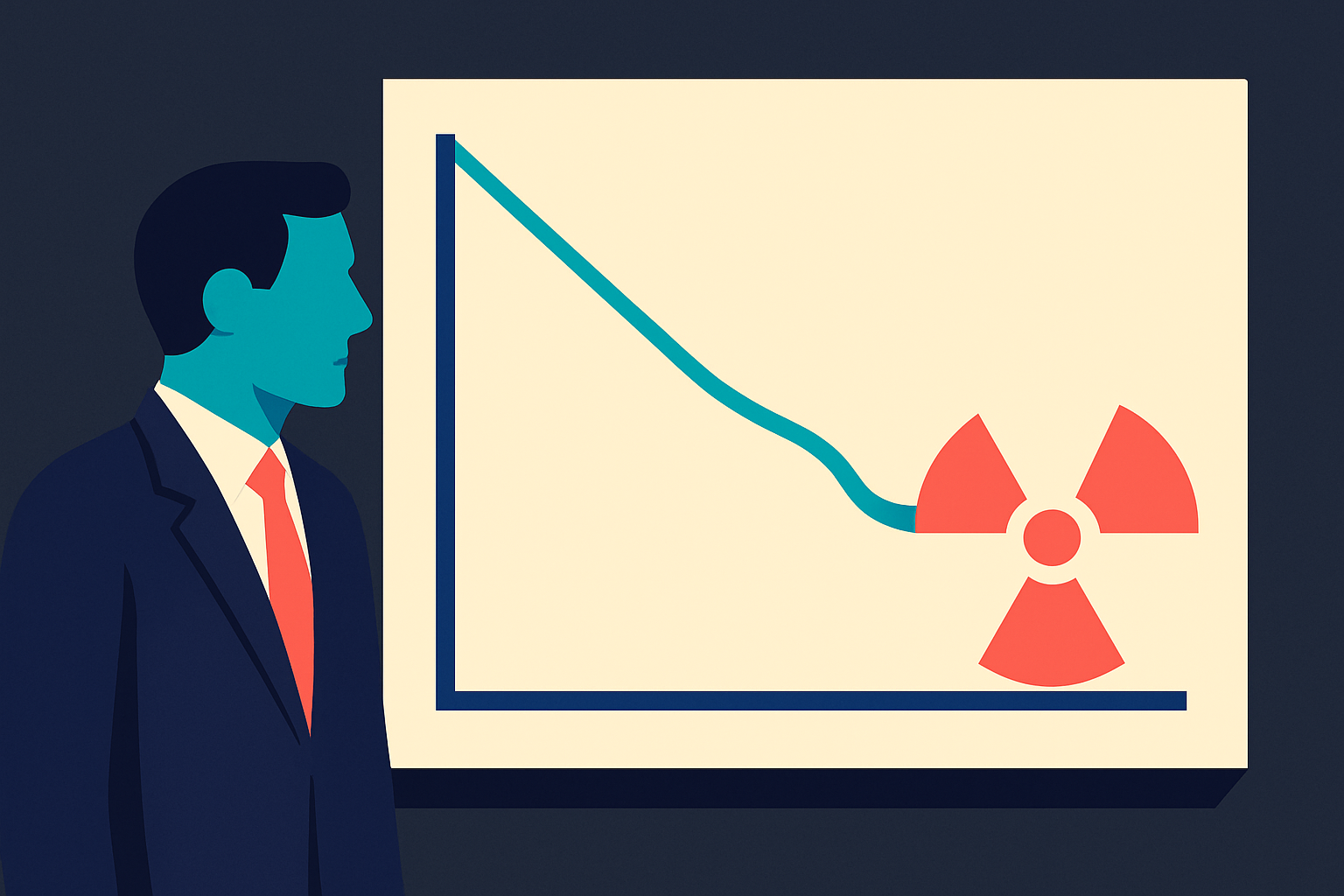
Linear No Threshold (LNT) is an outdated model of radiation risk
The Nuclear Regulatory Commission (NRC) uses a "Linear No Threshold" (LNT) model to assess radiation risk, but it doesn't accurately reflect the risk of dosage over time
Details
Core information and root causes
Per The Breakthrough Institute:
The Linear No-Threshold (LNT) model, which presumes that any dose of ionizing radiation carries a proportional risk of harm, has been the basis of radiation protection around the world for more than fifty years. This model underpins the regulatory frameworks of the U.S. Nuclear Regulatory Commission (NRC), the Department of Energy (DOE), and the Environmental Protection Agency (EPA).... While extensive research has expanded understanding of the effects of small radiation doses, significant uncertainty persists, particularly at doses below 100 mSv. Epidemiological studies in this range face significant limitations, as any potential increase in cancer risk is statistically indistinguishable from the normal background incidence of cancer and is confounded by a multitude of lifestyle and environmental factors. Consequently, the LNT model's assumption of a linear, proportional risk extending down to zero dose is not a proven scientific certainty but rather a conservative, simplifying assumption used for regulatory policy in the face of this ambiguity.1
Efforts
Current initiatives and solutions
Groups working on this bottleneck
Related
Connected bottlenecks and relationships
Approach
Strategic approach and implementation plan
Vectors for addressing
Replace LNT with a model that more closely matches both theory and evidence. As one workable alternative, [Jack Devanney] suggests using a sigmoid, or S-curve, instead of a linear fit, in a model he calls Sigmoid No Threshold. In this model, risk is monotonic with dose (there are no beneficial effects at low doses) and it is nonzero for every nonzero dose (there is no “perfectly safe” dose). But the risk is orders of magnitude lower than LNT at low doses. S-curves are standard for dose-response models in other areas.2
Risk-informed regulation: Agencies could implement more flexible risk thresholds that better balance safety against other societal benefits, rather than adopting extremely conservative lifetime risk standards. Current implementation of ALARA principles heavily leans towards ambiguous definitions of “adequate protection” which assume risks should be near zero by default, instead of “ample margin of safety” which has quantitative definitions.3
Contextual dose limits: A tiered system of radiation thresholds would reflect a reasonable balance of safety without undue burden. This includes setting a higher limit when doses under natural variation are not regulated and a slower increase when protective actions are required within the dose rates that show the highest likelihood of not being harmful. A tiered system can be implemented in the near term since it would not require a change of rule-making within both the NRC's and EPA's discretion. The first tier, up to the current public dose limit, would be exempt from regulation since it is less than the dose from someone moving from one house to another or from a low elevation to a high elevation. The second two tiers would progressively increase protection for the public and then workers. Beyond that would be an occupational limit within any one year. This both reduces regulatory burden and creates a more flexible but science-based safety regime.3
Recognition of comparative risks: Despite the administration's normal defense of fossil fuels, even the executive acknowledges that “the reality that substitute forms of energy production also carry risk, such as pollution with potentially deleterious health effects.” These other risks, like particulate matter (PM) are weighed against their ubiquity, relative risk, and their emissions from industries and technologies that are otherwise beneficial for society. Regulations must consider the impact of alternatives that will be used in place, or potentially result in increasing risk from more harmful sources of energy3
Replacing the “as low as reasonably achievable,” or ALARA standard, and linear no-threshold (LNT) modeling with risk-informed, performance-based frameworks.4
Resources
Sources, references, and supporting materials