
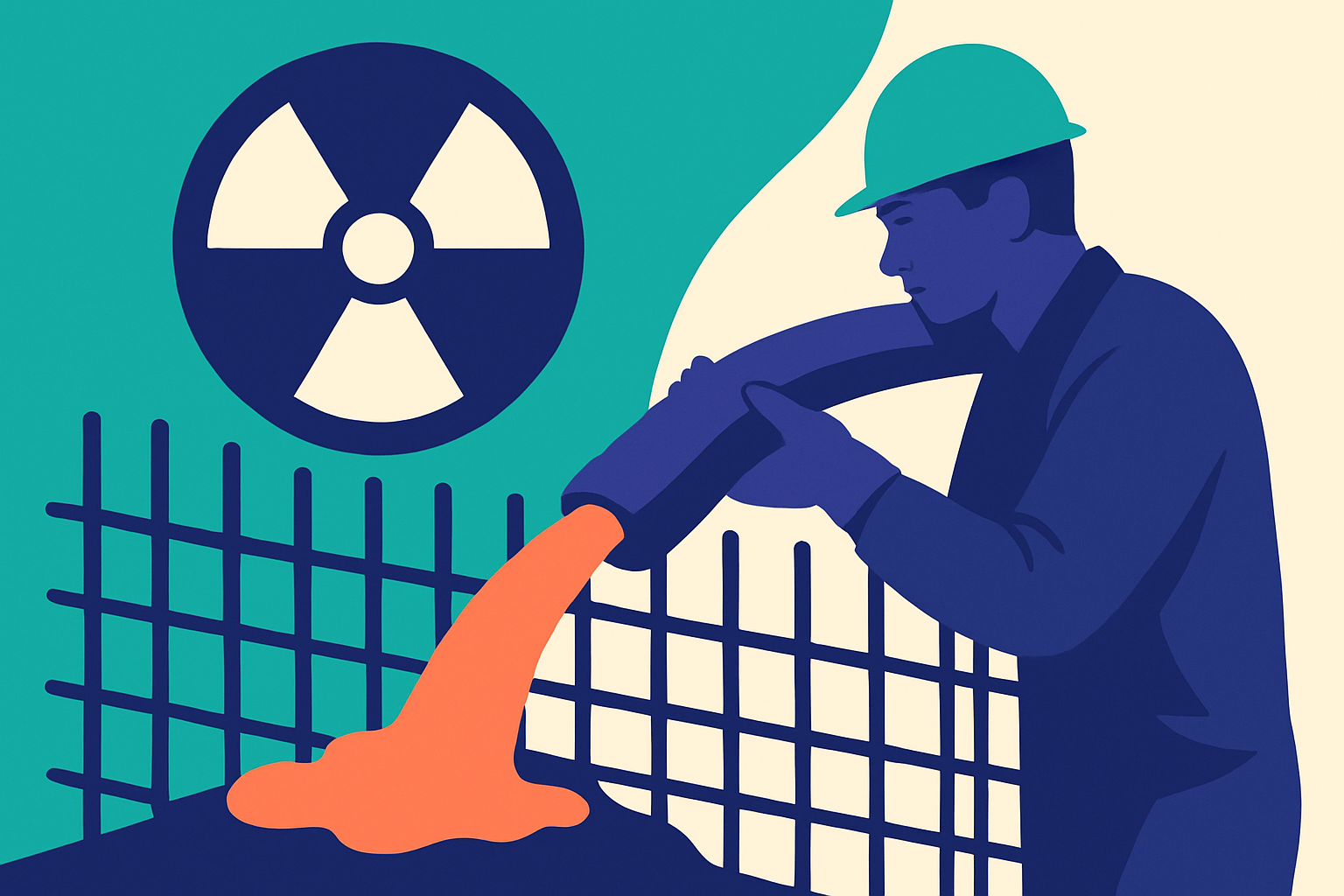
Concrete used in nuclear facilities has placement challenges
Concrete used in nuclear facilities has to meet additional specifications due to security specifications; pouring concrete around the additional rebar is difficult
Details
Core information and root causes
Why it matters:
“The concrete pours for nuclear concrete take a lot of time, about twice as long for foundations, and 50 percent longer for superstructures, compared to ordinary concrete.”
“Nuclear plants require a significant amount of concrete for the foundations, as well as the containment building. Because it performs a shielding function, nuclear plant concrete must meet the stringent QA/QC and documentation requirements that other safety-related components meet."
"Meeting these requirements for a site-produced material is difficult. Nuclear concrete typically has multiple closely-spaced reinforcing bars that can be difficult to arrange in the proper position, or pour concrete around (the Royal Academy of Engineer’s 30-page Guide to Nuclear Concrete mentions “congestion” 13 times.) Concrete placement issues seem to have plagued every recent nuclear project, and are frequently the source of delays and cost overruns. Incorrectly placed rebar on Vogtle 3 and 4 in Georgia caused a 6 month project delay. A similar issue caused a 4 month delay on the VC Summer plants, as well as delays at Flamanville in France. For the Olkiluoto 3 in Finland, poor concrete composition (along with other issues) caused a 9-month delay.”
— Brian Potter, Construction Physics1
Related
Connected bottlenecks and relationships
Approach
Strategic approach and implementation plan
Vectors for addressing the bottleneck
Employ structural designs that require less concrete
“...a simpler strategy than reducing the cost of nuclear-grade concrete is to just use less of it. Two nuclear plants now under construction are trying this route. One is the GE-Hitachi BWRX small modular reactor, with a basemat and reactor building that will be built from modules made of steel and concrete.
Researchers recently tested steel and concrete composite blocks at Purdue University to simulate loading conditions that they would see in an earthquake, and found that their strength exceeded expectations. Two steel plates are connected with adjoining steel plates with holes to allow insertion of concrete. The modules can be factory-fabricated and assembled on site, and then filled, allowing for quicker construction. With the composite-blocks, the re-bar typical in nuclear-grade concrete is no longer needed. GE-Hitachi hopes to cut construction costs by 10 percent with the technique.” 2
Minimize the critical area requiring nuclear-grade concrete
The Natrium project, in Kemmerer, Wyoming, is taking a different approach. It separates the reactor from the “energy island,” the part of the plant that produces electricity by using steam to spin a turbine and then a generator. In a conventional reactor, these components are adjacent, but Natrium, designed by TerraPower, uses the reactor to heat up a big external tank filled with molten salt. The salt’s main function is to be a battery, storing heat energy by varying its temperature. Operators can draw heat off the salt to boil water and make electricity, but at variable rates so they can time their production to match price changes on the grid. A side benefit, though, is that the part of the plant that has to meet nuclear-grade standards is substantially smaller. Concrete for the area away from the reactor can be fabricated to normal industrial standards. The NRC has recently endorsed the concept of a smaller “nuclear island,” separate from the “energy island” where electricity is made, although the Kemmerer plant does not yet have a construction permit for the nuclear portion.2
Use fuel types with containment properties that negate the need for a concrete dome around the reactor
Today’s reactors are fueled by ceramic pellets wrapped in thin metal tubes. The entire reactor lives within the containment, which is a very strong building. If cooling stops and the pebbles overheat, they can leak radioactive materials into the cooling water and if that water boils it can raise the pressure in the primary cooling system, opening a valve and sending radioactive steam into the containment. But the pebbles, more properly called Tristructural Isotropic, or TRISO, have particles of fuel wrapped in concentric layers of heat-resistant materials. Thus, the containment doesn’t have to be a concrete dome building surrounding the reactor; the containment can be the fuel itself. With this technology, there is one less significant reason to hermetically seal the building that houses the reactor. For example, in Kairos Power’s SMR design the fuel floats in a salt mixture that can withstand tremendous heat without boiling away. If the fuel fails, the salt will absorb the radionuclides. This means the whole operation is low pressure, despite being very high temperature, making containment a lot less of an issue.2