
State-level restrictions & bans on nuclear development
State-level restrictions & bans slow (or prevent) nuclear development
Details
Core information and root causes
Context
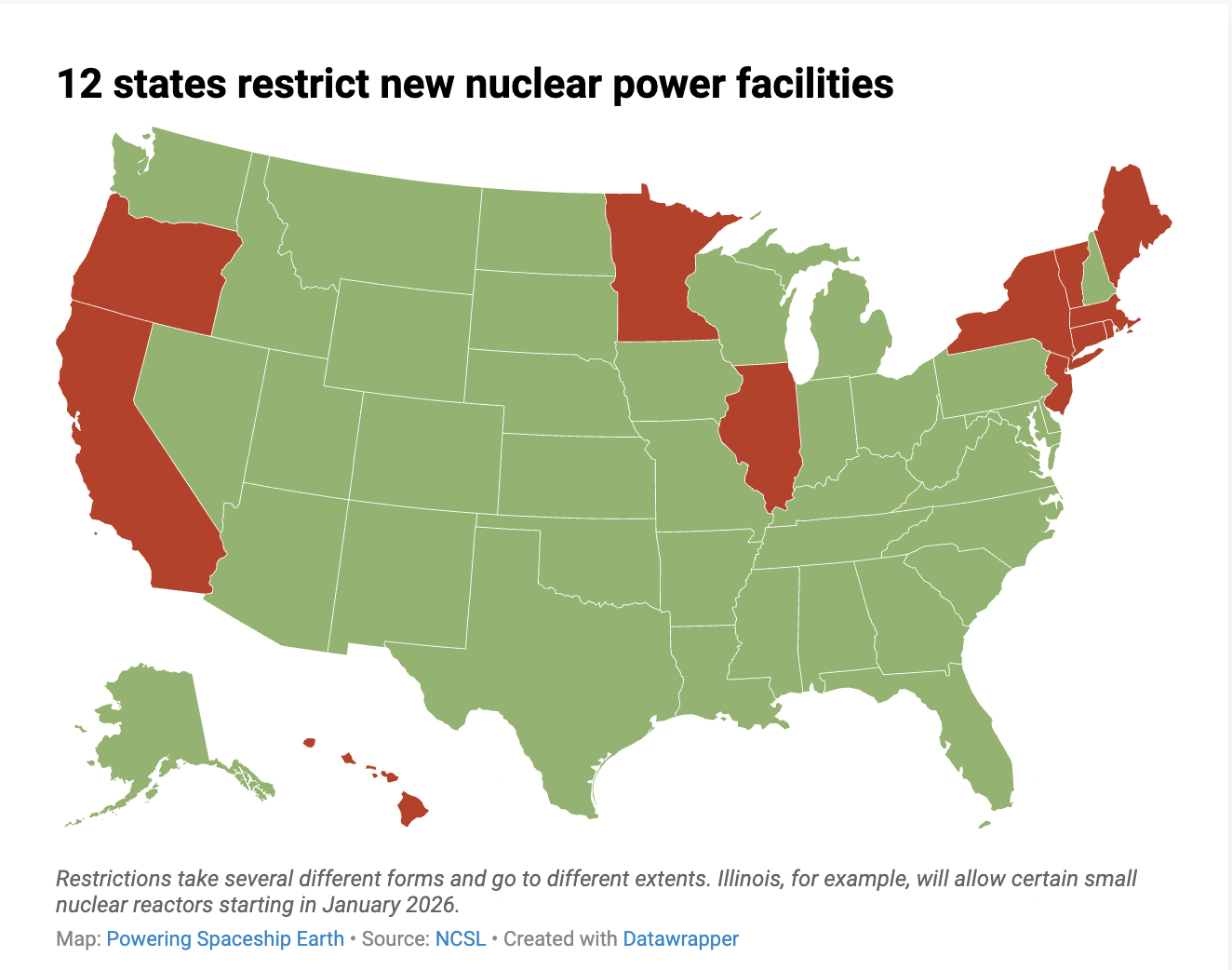
Across the country, a dozen states still maintain statutory restrictions on the construction of new nuclear facilities. These laws, written decades ago, were often driven by fear and misunderstandings rather than practical safety needs. They now function as blanket barriers to innovation—even as nuclear technology evolves and energy needs grow... We can sort them into four buckets:
- Outright bans
- Minnesota: Prohibits new nuclear plants altogether.
- New York (Long Island only): A limited regional ban.
- Waste disposal requirements
- California, Connecticut, Illinois, Maine, and Oregon: Require proof of a federally approved technology for high-level waste disposal before construction can begin.
- New Jersey: Requires a state commissioner to certify the safety of waste disposal plans.
- Legislative or voter approval
- Hawaii, Illinois, Massachusetts, Rhode Island, and Vermont: New reactors need explicit legislative approval.
- Maine, Massachusetts, and Oregon: Construction can’t proceed without statewide voter approval.
- Multi-layered hurdles
- Massachusetts: Demands both a popular vote and legislative certification of emergency plans, a permanent and federally licensed waste-disposal facility, decommissioning methods, emission standards, and “optimality” compared to alternatives.
— Josh Smith, writing for "Powering Spaceship Earth"1
"...states with nuclear prohibitions represent 27 percent of U.S. electricity customers but only 15 percent of nuclear reactors, indicating that there likely would be more NPPs if not for these prohibitive policies."
— R Street2
Progress
"By the end of 2023, Connecticut, Illinois, Kentucky, Montana, West Virginia, and Wisconsin had repealed laws prohibiting the deployment of new NPPs or adopted modifications that made it easier to build nuclear power in their states. This is likely a result of public interest in cleaner power generation as well as improved public understanding of nuclear power safety"
— R Street2
Efforts
Current initiatives and solutions
Groups working to address this bottleneck
- Abundance Institute
Related
Connected bottlenecks and relationships
Resources
Sources, references, and supporting materials